When your eyes stop focusing up close and you still want to be able to see objects at multiple distances, the optician usually reaches for the same answer: progressive lenses. They’re the default, and for a lot of people that’s fine. But a default is just the most common choice, not automatically the best one for you. So before you sign off on another pair of progressives, here’s the full menu, laid out honestly, including the options the shop down the street may not push because the margins are thinner. If you’ve already settled on glasses and just want help choosing a pair, see our buyer’s guide, Best glasses for presbyopia: a buyer’s guide.
Quick reminder on what we’re solving. After your mid-40s the lens in your eye stiffens and loses its ability to refocus, a near-universal change called presbyopia.[1] Every option below is just a different trick for adding the focusing power your eye can no longer supply. They differ in how they do it, who they suit, and what they cost you in money, comfort, and field of view.
Reading glasses: the simplest fix
A single magnifying power across the whole lens, sharp at one distance. Cheap, optically quite good, and there’s not much to adapt to if you’ve ever worn glasses before. The catch is that they only work at that one distance, so everything a few inches past the page you’re reading turns into a soft blur and you end up peering over the top or swapping them on and off all day. They work best for people whose near work happens at a single predictable distance with limited refocusing requirements: reading, a hobby bench, a fixed desk. A close cousin worth knowing about is the dedicated computer or office lens, set for the arm’s-length zone where most workstation screens live. This solves the specific complaint of people who spend their day staring at a monitor rather than a book.
Bifocals and trifocals: visible zones
Bifocals are Benjamin Franklin’s 18th-century idea, and they’re still around for good reason. A bifocal splits the lens into a distance zone up top and a near zone at the bottom, with a visible line between them; a trifocal adds an intermediate strip for arm’s-length tasks. The hard line is what people dislike cosmetically, and the world still jumps in magnification as your eye crosses it. But the zones are large and easy to find, which some wearers actually prefer to the hunt-for-the-sweet-spot feeling of progressives.
Progressive lenses: the popular default
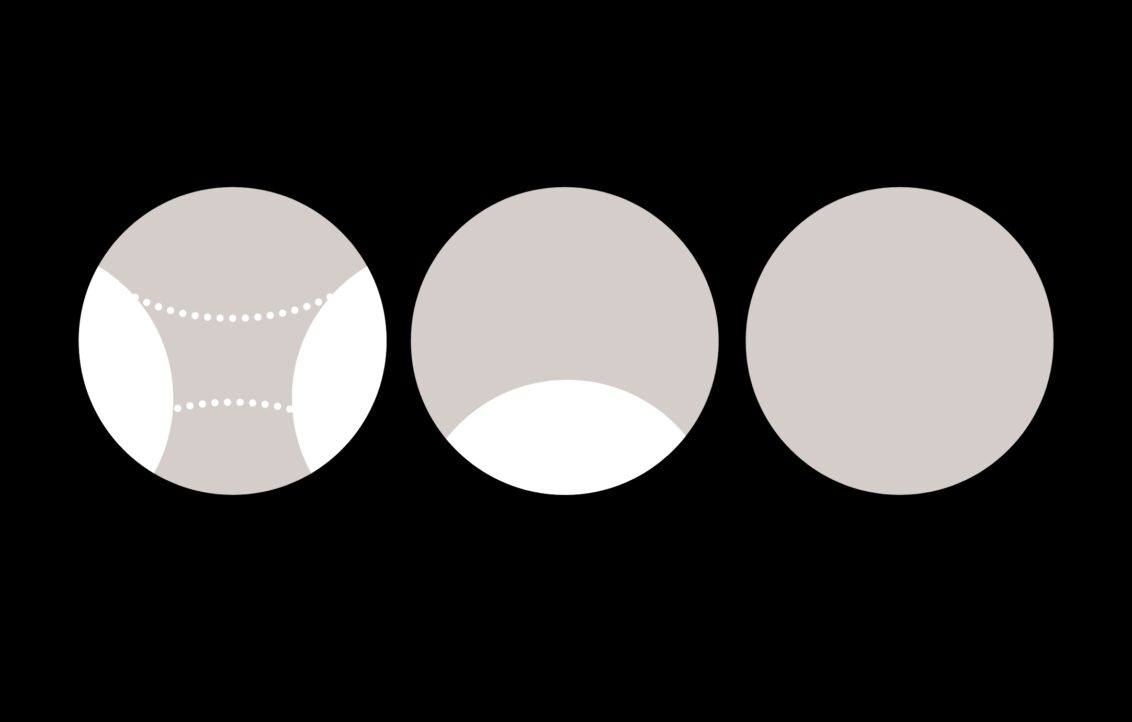
Progressives smooth the bifocal or trifocal zones into a seamless gradient, so there’s no visible line and the power ramps continuously from distance at the top to near at the bottom. That’s the appeal. The trade-offs are real, though. Only a narrow corridor is in focus at any moment, so you need to aim your nose at whatever you want to see, and the sides of the lens carry distortion that can make straight lines bend. This distortion directly scales with the amount of reading add you need, which means it gets worse over time. Adaption is another well-known hurdle: most people adapt within about two weeks, but around 5% of us will never be able to get accustomed to them and will have to switch to something else.[2] Another 10-15% will tolerate progressives because there’s currently nothing better in the market, but will pay a silent daily tax since their job or hobby is fundamentally incompatible with the progressive corridor design: think people in visually demanding professions like engineers or jewelers. Also, there’s a safety footnote too: older adults in progressives have higher fall rates than single-vision wearers, with one study finding them more than twice as likely to suffer multiple falls as bifocal wearers.[3]
Contacts: monovision or multifocal
If you would rather not wear glasses at all, contacts correct presbyopia two ways. Monovision sets one eye for distance and the other for near and lets your brain choose; multifocal contacts build distance, intermediate, and near into every lens. Both ask for a small trade in depth perception or contrast, and across trials most wearers prefer multifocals.[4] We cover how to choose between them, and how to trial them first, in Contact lenses for presbyopia: monovision vs multifocal.
Adaptive (autofocus) lenses: the newest contender
The most recent arrival tries to remove the core compromise entirely. Instead of baking fixed zones into the glass, adaptive lenses are designed to change their focusing power electronically, aiming to keep a single pair sharp whether you’re reading a label or looking down the street, without the head-aiming that progressives demand. It’s a genuinely promising direction. It’s also early: availability is limited, prices run high relative to conventional eyewear, and the category is still emerging. For most people, it’s still a piece of sci-fi sounding novelty, but the trend is here to stay and shows how technology strives to evolve with our needs as we grow older as a species.
The options at a glance
Here’s a quick breakdown outlining who each option suits and what it costs you in return.
| Option | Best for | Main trade-off |
|---|---|---|
| Reading glasses | Predictable near work at one distance | Only sharp at that distance; constant on/off juggling |
| Bifocals / trifocals | Wanting large, easy-to-find zones | Visible line; image jumps between zones |
| Progressive lenses | One discreet pair for most situations | Narrow focus corridor; up to 15% of users will not adapt |
| Monovision contacts | Low add powers, glasses-free daily life | Reduced depth perception and crispness |
| Multifocal contacts | Glasses-free across all distances | Slight contrast loss; higher cost; suboptimal for very near vision |
| Adaptive / autofocus | Early adopters wanting no fixed zones | Limited availability; high price; early-stage |
A simple way to choose
Skip the brand names and start with your day. If you’re not fully presbyopic and your near vision demands predictable performance at a fixed distance, dedicated reading/computer glasses are hard to beat on sharpness and price. If you want one pair to cover everything and don’t mind a short adaptation and some additional neck & head work for “aiming”, progressives earn their popularity. If you’d rather not wear glasses at all, contacts are the path: try multifocals first for smoother all-distance vision, and consider monovision if your add is still low and cost matters. If you drive a lot at night, value depth perception, or have already failed to adapt to progressives, weight the options that preserve a wide, stable field of view. And if you’re the type who tracks where the technology is heading while actively looking for better vision solutions, keep an eye on adaptive glasses in the very near future.
There’s also the pinhole route worth a mention: a prescription drop called Vuity (pilocarpine), FDA-approved in 2021, temporarily shrinks the pupil to sharpen near vision for a few hours, though it fades quickly and really struggles in dim light.[5] It’s a supplement to the options above, not a replacement.
There is currently no universal right answer, and there may not ever be – our needs are different and we need to acknowledge that. There are trade-offs between sharpness, convenience, field of view, and cost, and the best choice is simply the one that fits how you live, work and play. Bring that perspective to your next eye exam, and the decision gets a lot easier.