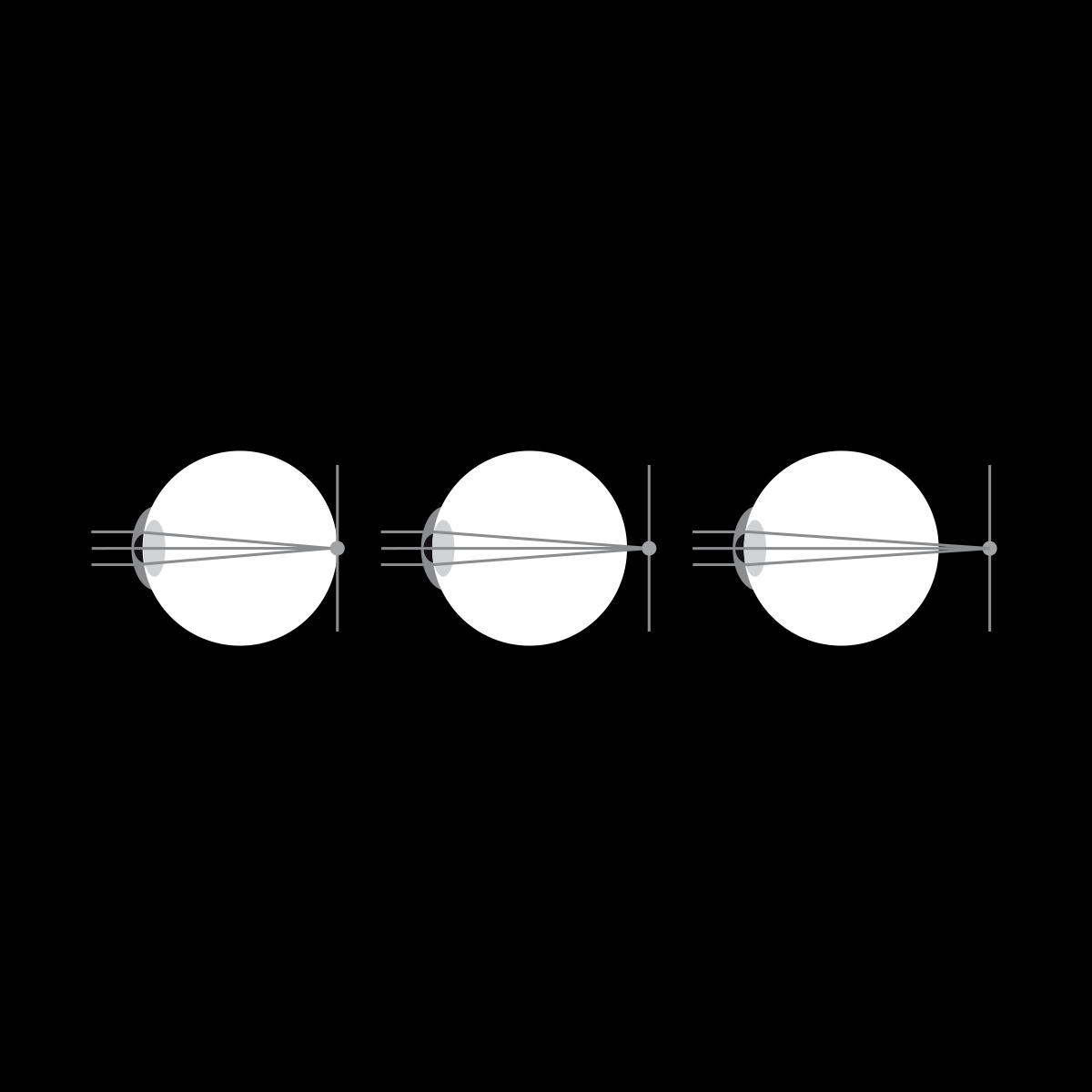
If you have ever walked out of an eye exam with a new word for why the world looks soft, you have probably noticed they all start to blur together: myopia, hyperopia, presbyopia. They sound like the same problem dressed in different Latin, and most people quietly file them all under “my eyes are getting worse.” They are not the same problem, though. Presbyopia vs myopia vs hyperopia is really a story about two completely different things going wrong: one is about the shape of your eye, and the other is about your aging lens losing its flex. Sort that out and the confusion clears up fast, so let’s do exactly that, in plain English and with no pitch.
The short version: three different problems
Here is each one in a single line, and then we will unpack them.
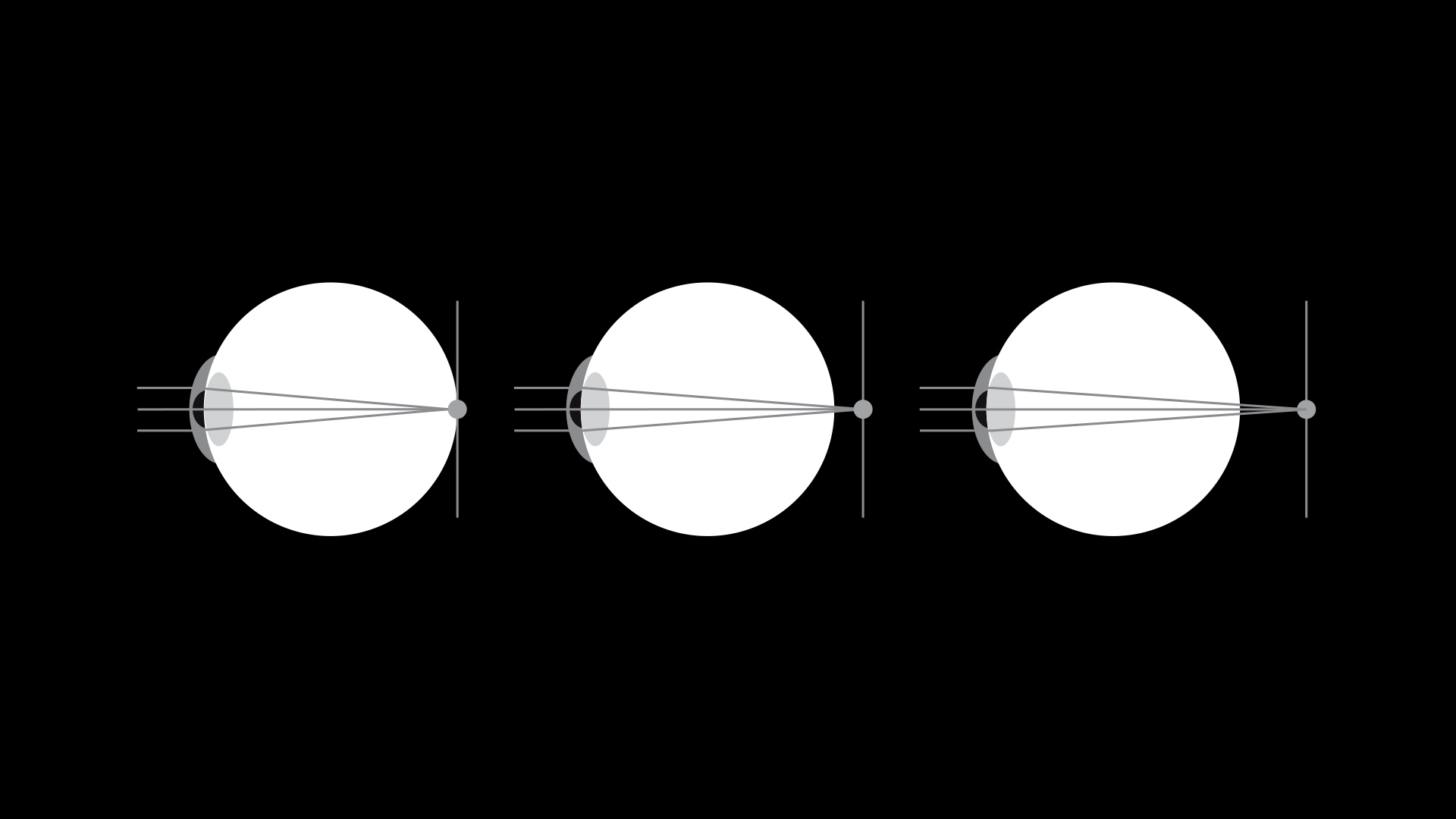
Myopia (nearsightedness) means distant things are blurry while close things are sharp. Your eye is a touch too long, so it over-focuses.
Hyperopia (farsightedness) is the mirror image: your eye is a touch too short, so it under-focuses, and near work is usually the first thing to suffer.
Presbyopia is the odd one out. It is not about the shape of your eye at all. It is the age-related stiffening of the lens that takes away your ability to focus up close, and it arrives for nearly everyone in their mid-40s.[1]
The key split: myopia and hyperopia are refractive errors, baked into the physical dimensions of your eye and usually present from childhood. Presbyopia is a focusing problem that develops with age, on top of whatever else your eyes were already doing. That is why you can be nearsighted your whole life and still get presbyopia at 45, and why the fix for one does nothing for the other.
Myopia (nearsightedness): the eye is too long
Think of your eye as a camera. Light comes in through the cornea and lens at the front and is supposed to land in a sharp point on the retina at the back. In a myopic eye, the eyeball is slightly too long from front to back, or the cornea is too steeply curved, so the light comes to a focus just in front of the retina instead of on it. By the time it reaches the retina the image has already started to spread back out, and distance vision goes soft. Close objects, which need more focusing power anyway, still land correctly, which is why a nearsighted person can often read a book comfortably without glasses but cannot read a street sign.[2]
Myopia typically shows up in childhood or the teenage years, often progresses through the school-age growth years, and tends to stabilize in early adulthood. It is also becoming dramatically more common. By one widely cited projection, about 23% of the world was myopic in 2000, and that figure is expected to reach roughly 50%, close to five billion people, by 2050.[3] It is corrected with a concave “minus” lens that spreads the light out a little before it enters the eye, nudging the focal point back onto the retina.
Hyperopia (farsightedness): the eye is too short
Hyperopia is myopia’s opposite. Here the eyeball is a little too short, or the cornea too flat, so the light has not finished focusing by the time it hits the retina. Its focal point sits behind the retina, and the image lands slightly blurred.[2] Because focusing up close demands the most work, near vision usually feels the strain first, although in stronger cases distance can suffer too.
There is one twist that matters for this whole comparison. Young, farsighted eyes have a hidden talent: they can use the eye’s own focusing muscle to compensate for a mild shortfall, effectively “focusing away” the error so vision feels normal, sometimes with eye strain or headaches as the only clue. That trick relies on the very flexibility that presbyopia later takes away. So as a farsighted person ages and the lens stiffens, the compensation fails, and their near blur tends to arrive earlier and feel worse than it does for everyone else. Hyperopia is corrected with a convex “plus” lens that adds focusing power and pulls the focal point forward onto the retina.
Presbyopia: the lens stops flexing
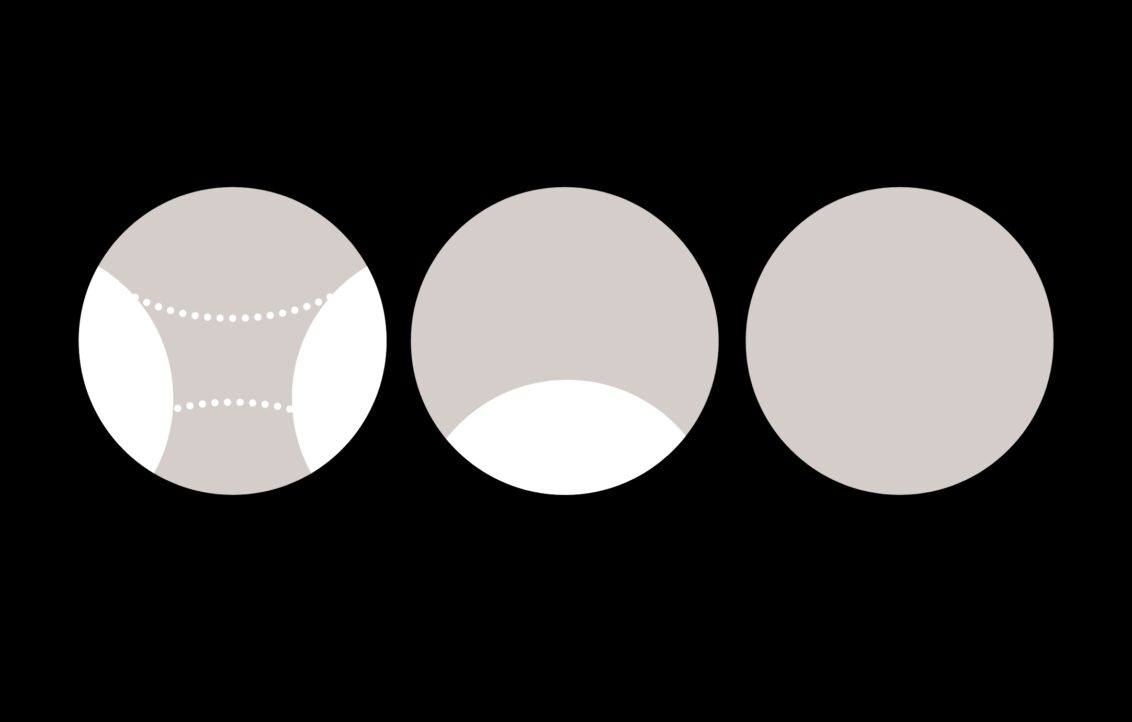
Now the different animal. Presbyopia has nothing to do with how long or short your eyeball is. It is about the lens losing its ability to change shape. When you are young, a ring of muscle squeezes the lens to make it fatter for close-up focus and lets it flatten for distance, a trick called accommodation. The lens never stops growing throughout life, getting larger, denser, and stiffer, until the muscle can no longer reshape it.[1] The focusing range quietly shrinks, near vision goes first, and by the early 40s the restaurant menu starts drifting to arm’s length. Symptoms typically begin between 40 and 45 and are near-universal by about 52.[1]
Here is the part that sets presbyopia apart from the other two. Myopia and hyperopia are a fixed mismatch: your eye focuses in the wrong place by a steady amount, and a steady amount of correction fixes it. Presbyopia is a moving target. The problem is specifically that your eye can no longer change its power as you shift between near and far, so the amount of help you need depends on the distance you are looking at right now. That single fact is why presbyopia is so much more awkward to correct, and it is the reason bifocals, progressives, and readers all exist as compromises. It is corrected by adding “plus” reading power for near tasks, whether in readers, a bifocal segment, a progressive corridor, or contacts.
Presbyopia vs myopia vs hyperopia at a glance
| Myopia (nearsighted) | Hyperopia (farsighted) | Presbyopia | |
|---|---|---|---|
| Root cause | Eyeball too long / cornea too steep | Eyeball too short / cornea too flat | Lens stiffens and loses flex with age |
| What’s blurry | Distance; near stays sharp | Near first; distance in stronger cases | Near, at any prior distance vision |
| Typical onset | Childhood / teens | Often present from birth | Mid-40s, near-universal by ~52 |
| Changes with age? | Usually stabilizes in adulthood | Can surface later as accommodation fades | Progresses steadily into the 50s |
| Corrected with | Concave “minus” lens | Convex “plus” lens | Added “plus” reading power for near |
Presbyopia vs myopia: the one people mix up most
This is the comparison that trips up the most people, partly because the words rhyme and partly because they can feel similar day to day. The clean way to keep them straight: myopia is about distance and shape, presbyopia is about near and age. A myopic person has trouble seeing far away and has had it for years, usually since school. A presbyopic person has trouble seeing up close and noticed it recently, in their 40s. The mechanisms are unrelated, which is why correcting one does nothing for the other.
There is a small wrinkle that adds to the confusion. A lifelong nearsighted person who reaches presbyopia often discovers they can simply take their distance glasses off to read, because their eyes are “pre-set” for near. That can feel like a perk, but it is really just two opposite errors briefly canceling out at one specific distance, not presbyopia being any milder.
Hyperopia vs presbyopia: farsighted vs presbyopia
Hyperopia vs presbyopia is the trickiest pair, because both can blur near vision and people often use “farsighted” loosely to mean both. The difference is the cause and the timing. Farsightedness comes from the shape of your eye and can be present from birth, affecting people at any age. Presbyopia comes from the aging lens and arrives on a predictable schedule in midlife. You can have one, the other, or both at once, and a farsighted person is the classic case of “both,” which is why their near struggles tend to start early. If someone says they have been farsighted since childhood, that is hyperopia. If their near vision was fine until their 40s, that is presbyopia.
Can you have more than one at the same time?
Yes, and it is common. Presbyopia is universal with age, so it stacks on top of whatever refractive error you already had. A nearsighted person becomes nearsighted-plus-presbyopic and may juggle distance glasses with separate readers, or move to progressives. A farsighted person becomes farsighted-plus-presbyopic and often feels the near blur sooner and more sharply than their peers. You cannot, however, be both purely nearsighted and purely farsighted in the same eye at the same time, since the eyeball cannot be both too long and too short at once. (Astigmatism, a separate issue caused by an irregularly shaped cornea, can ride along with any of these, but that is a story for another post.)
How each one is corrected (and where one pair for everything fits)
Because myopia and hyperopia are fixed errors, a single steady lens power fully corrects each one: minus lenses for nearsightedness, plus lenses for farsightedness, and once you have the right prescription, one pair handles all distances comfortably. The eye still does its own focusing; the glasses just shift the starting point.
Presbyopia is the hard case precisely because the eye has lost the ability to refocus itself. There is no single steady power that fixes near and far at the same time, so every conventional solution divides the lens into zones or asks you to swap pairs. Readers fix near and blur the rest. Bifocals split the lens with a visible line. Progressives smooth that line into a corridor at the cost of soft, swimmy edges. They are all clever workarounds for the same root problem: the focusing power is frozen into the glass, so it cannot follow you as you look from your phone to the far wall.
This is also where presbyopia points toward a different kind of fix. Since the real loss is the eye’s ability to change its own power with distance, the natural answer is a lens that changes its power for you. That is the idea behind adaptive, or autofocus, eyewear, which uses sensors to tell where you are looking and a tunable lens that adjusts in real time, so one pair can stay sharp from near to far without fixed zones. It is still early and not yet on shelves as an automatic everyday pair, but it is worth understanding why presbyopia, unlike myopia or hyperopia, is the condition practically built for a focus that moves.